Introduction
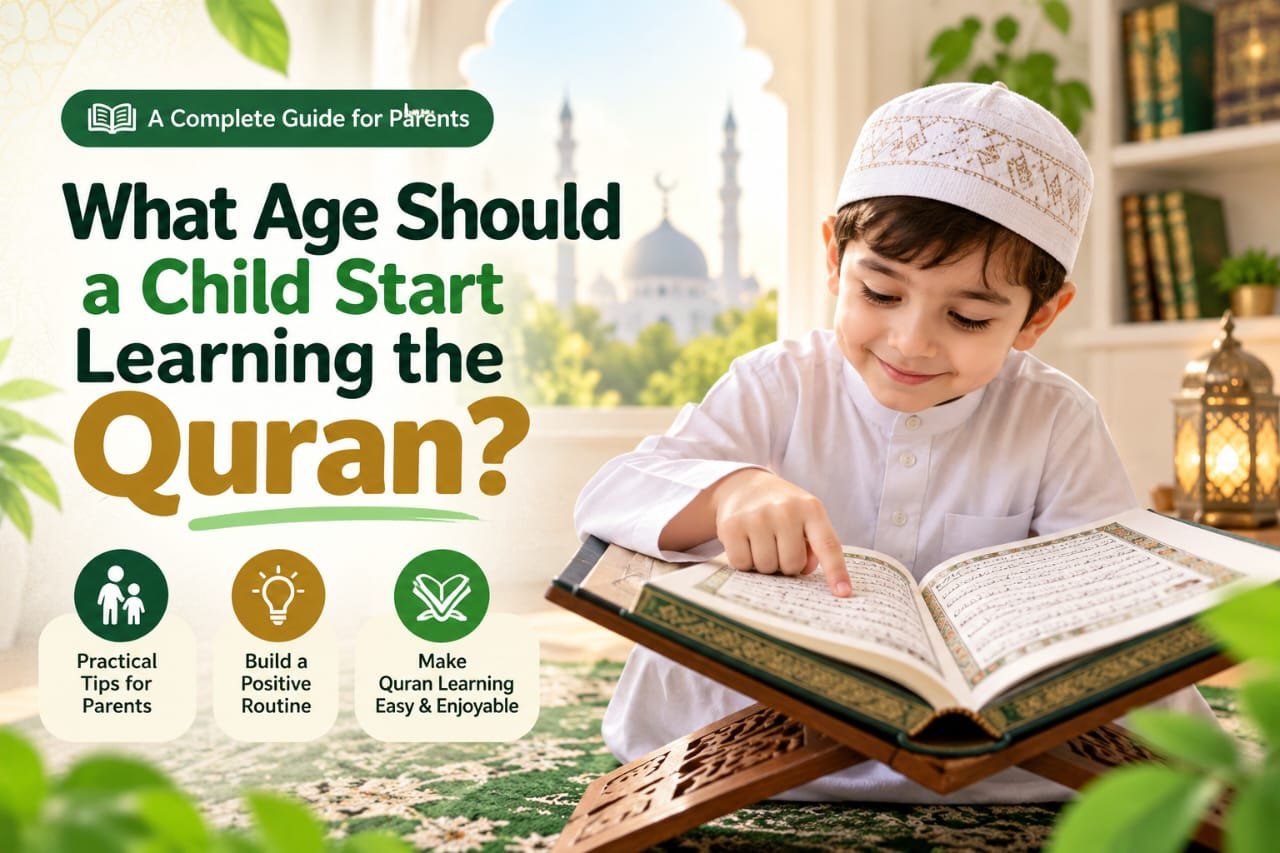
One of the most common questions parents ask is: “What age should a child start learning the Quran?”
There is no single age that is perfect for every child. However, many children can begin becoming familiar with the Quran and basic Islamic learning from around 4 to 6 years old, depending on their attention span, communication skills, communication ability, and readiness.
Understanding what age should a child start learning the Quran can help parents choose a learning approach that matches their child’s age, abilities, and readiness.
The most important thing is not to pressure a child. Quran learning should be introduced with kindness, patience, encouragement, and a positive routine.
What Age Should a Child Start Learning the Quran?
Many children can start basic Quran learning at an early age. At first, the goal does not need to be reading long passages. Young children can begin with simple Islamic words, Arabic letters, short Surahs, daily duas, and basic Quran pronunciation.
For some children, age 4 or 5 may be a good time to begin Noorani Qaida. Other children may be ready at 6 or 7. Every child develops differently.
Parents should look for signs that their child is ready to sit for a short lesson, listen to a teacher, repeat sounds, and follow simple instructions.
Parents can also explore our Kids Quran & Islamic Learning Course, which is designed for young learners and includes Noorani Qaida, basic Tajweed, Quran reading, Islamic studies, and age-appropriate learning.
Knowing what age should a child start learning the Quran is only the first step. Parents should also consider the child’s attention span, learning style, and ability to follow simple instructions.
Choosing the Right Starting Point for Your Child
Children do not all begin Quran learning at the same level. Some children may already recognize Arabic letters, while others may be completely new to Arabic reading.
The best approach is to start from the child’s current ability and gradually build the necessary skills.
| Learning Stage | Typical Starting Point | Main Skill Focus | Useful Progress Sign |
|---|---|---|---|
| Beginner | Little or no Arabic reading | Arabic letters and Noorani Qaida | Recognizes letters and basic sounds |
| Quran Reading | Basic Arabic recognition | Fluency and correct reading | Reads short passages with greater confidence |
| Tajweed | Functional Quran reading | Accurate Tajweed application | Applies learned rules correctly |
| Hifz | Suitable Quran reading level | Memorization and revision | Recalls memorized Surahs consistently |
| Advanced | Fluent Quran reading | Precision and independence | Reads accurately with minimal correction |
Why Should Children Learn the Quran at an Early Age?
Starting Quran learning early can help children become familiar with the Quran and develop a positive relationship with it.
Here are some benefits of starting at a young age:
1. Children Become Familiar with Arabic Letters
Young learners can gradually recognize Arabic letters and their sounds through simple and repeated practice.
2. Children Develop Good Quran Reading Habits
A regular Quran routine can become a natural part of a child’s daily life.
3. Tajweed Can Be Learned Step by Step
Learning correct pronunciation from the beginning can help children avoid developing incorrect reading habits.
4. Children Can Learn Short Surahs and Duas
Along with Quran reading, children can gradually memorize short Surahs and important daily duas.
5. Quran Learning Can Build Confidence
When children learn small lessons and receive encouragement, they can become more confident in their Quran reading.
What Should a Child Learn First?
For a young beginner, Quran learning should be simple and age-appropriate.
A child may begin with:
- Arabic letters
- Basic letter sounds
- Noorani Qaida
- Harakat such as Fatha, Kasrah, and Dammah
- Joining letters
- Basic Tajweed rules
- Short Surahs
- Daily duas
- Islamic manners and basic teachings
The goal should be gradual progress rather than trying to teach too much in one lesson.
How Long Should a Child Study the Quran Each Day?
Young children usually learn better through short and focused lessons.
A 20–30 minute Quran lesson can be suitable for many young learners, although the ideal lesson length depends on the child’s age, attention span, and learning level.
Parents should focus more on consistency than on making lessons unnecessarily long.
A short lesson every day or several times a week can be more effective than a long lesson that makes the child tired or frustrated.
How Can Parents Make Quran Learning Easier for Children?
Parents can play an important role in making Quran learning enjoyable.
Understanding what age should a child start learning the Quran can also help parents set realistic expectations and create a learning routine that is appropriate for their child’s age.
1. Create a Regular Routine
Choose a consistent time for Quran learning so that the child knows when it is time for the lesson.
2. Keep Lessons Positive
Avoid making Quran learning feel like a punishment. Encourage your child and celebrate small improvements.
3. Give Your Child Time
Every child learns at a different speed. Avoid comparing your child with other children.
4. Practice a Little at Home
Even five to ten minutes of revision can help children remember what they learned in their lesson.
5. Encourage Your Child
Simple words such as “MashaAllah,” “Well done,” and “Keep trying” can make a big difference.
6. Choose the Right Teacher
A good Quran teacher should understand how to communicate with children and should teach with patience, kindness, and encouragement.
Should Children Learn Quran with Tajweed?
Yes. Children should gradually learn correct Quran pronunciation and Tajweed as they become ready.
However, Tajweed should be taught according to the child’s level. Young children do not need to memorize a large number of complicated rules at once.
A teacher can introduce simple rules step by step and give the child enough practice to apply them correctly.
Parents interested in structured Quran reading can also explore our Quran Reading with Tajweed course.
What If My Child Is Older and Has Not Started Quran Yet?
It is never too late to start learning the Quran.
Some children begin at a very young age, while others start later because of school, family circumstances, or other reasons.
Parents should not feel discouraged if their child is older and still needs to begin with the basics.
With a patient teacher, a suitable learning plan, and regular practice, children can make excellent progress at different ages.
Online Quran Classes for Children
Online Quran classes can be a convenient option for families who want their children to learn from home.
One-to-one online classes can allow the teacher to focus on the individual child’s reading level, pronunciation, Tajweed, strengths, and areas that need improvement.
Online learning can also be helpful for families living in countries where finding a suitable Quran teacher nearby may be difficult.
At Yasir Online Quran Academy, children can learn Quran reading, Noorani Qaida, Tajweed, memorization, and Islamic studies through personalized online lessons.
Parents can choose a schedule that works with their family’s routine, while the teacher can give individual attention to the child.
Parents who want to read the Quran online can also explore Quran.com as an additional Quran resource.
If you are looking for a personalized learning option, you can apply for a free trial at Yasir Online Quran Academy.
Frequently Asked Questions
What age should a child start learning the Quran?
There is no fixed age for every child. Many children can begin basic Quran learning around 4–6 years old, depending on their readiness and development.
Can a 4-year-old learn the Quran?
Yes, some 4-year-olds can begin with Arabic letters, basic sounds, short lessons, and simple Islamic learning. Lessons should be short, engaging, and age-appropriate.
How long should a child’s Quran class be?
For many young children, a focused 20–30 minute lesson can work well. The ideal length depends on the child’s age and attention span.
Should my child learn Noorani Qaida before the Quran?
Noorani Qaida can provide a useful foundation for learning Arabic letters, pronunciation, joining letters, and basic reading skills before progressing to Quran reading.
Can older children start learning the Quran?
Absolutely. It is never too late to learn the Quran. Children can start from their current level and progress step by step.
How can I keep my child motivated to learn Quran?
Keep lessons positive, celebrate progress, avoid unnecessary pressure, maintain a regular routine, and choose a teacher who understands how to teach children patiently.
Conclusion
The best time to introduce a child to the Quran is when the child is ready to learn in a positive and supportive environment.
For many children, starting around 4–6 years old can be a good opportunity to build a strong foundation. However, there is no need to compare children or rush their progress.
For parents wondering what age should a child start learning the Quran, the most important thing is to begin with patience, encouragement, and an age-appropriate learning routine.
With patience, consistency, encouragement, and the right teacher, children can develop a lifelong connection with the Quran.
Looking for Online Quran Classes for Your Child?
Yasir Online Quran Academy provides personalized online Quran learning for children, including Noorani Qaida, Quran reading, Tajweed, memorization, and Islamic studies.
Our goal is to make Quran learning simple, engaging, and suitable for each child’s learning level.
Visit our Admission page to learn more about our online Quran classes and get your free trial.
May Allah make the Quran the light of our children’s hearts and guide them throughout their lives. Ameen.