What is the 3rd Kalima Tamjeed? (Meaning & Importance)
The 3rd Kalima, known as Kalima Tamjeed or teesri kalima tamjeed, is a declaration that glorifies Allah’s purity and greatness. It forms part of the six Kalimas of Islam and anchors a Muslim’s understanding of Tawheed and glorification of Allah. Yasir Online Quran Academy teaches its meaning as a core part of early Islamic learning.
Kalima Tamjeed sits third among the six foundational declarations every Muslim learns, right after the Shahadah and Kalima Shahadat. It’s short, but it carries weight: every word points back to Allah’s oneness and majesty. Kids and adults alike start here on the path toward deeper Islamic creed (Aqeedah).
So why does it matter so much? Because glorification isn’t just ritual, it’s remembrance. Reciting it daily keeps a believer’s heart oriented toward Allah’s greatness. That’s exactly why tutors at Yasir Online Quran Academy introduce it early, pairing recitation with simple, honest explanation kids can actually hold onto.
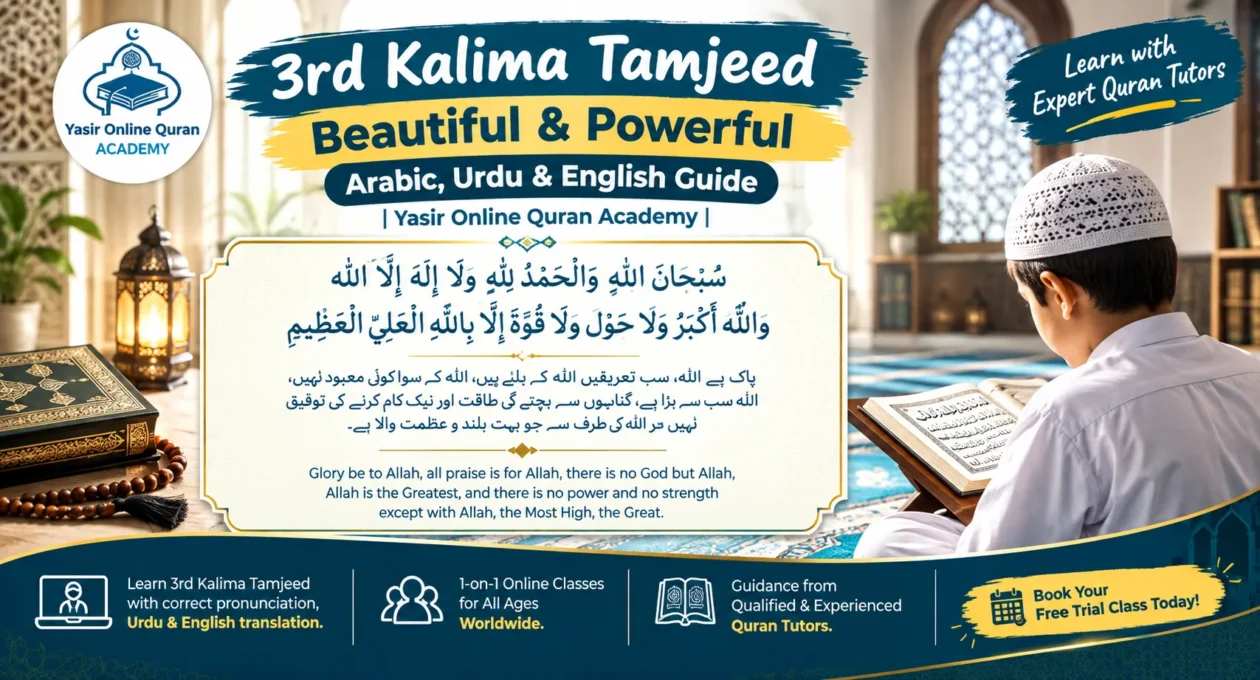
3rd Kalima Tamjeed in Arabic with Urdu Translation
The 3rd kalima tamjeed in Arabic opens with the phrase beginning “La ilaha illallahu wahdahu” and continues with further praise of Allah’s sovereignty. The kalima tamjeed with Urdu translation renders this meaning in accessible everyday language for Urdu-speaking learners. Verified text prevents the common script and translation errors found online.
Getting the Arabic right matters more than most people realize. One misplaced letter can shift meaning entirely, which is why memorizing from an unverified source is risky business. Yasir Online Quran Academy hands students teacher-checked Arabic script paired directly with accurate Urdu translation from day one.
Urdu translation isn’t just a courtesy, it’s a bridge. Many learners, especially children raised in English-speaking households, understand Urdu before they understand classical Arabic. Having both side by side turns rote memorization into genuine comprehension, something self-study apps rarely manage to deliver reliably.
3rd Kalima Tamjeed English Translation and Word-by-Word Meaning
The kalima tamjeed English translation conveys glorification of Allah’s holiness and freedom from imperfection, broken down word by word against its Arabic root. This method answers the common question, what does kalima tamjeed mean, in plain terms. It helps English-first learners build real understanding, not just memorized sound.
Word-by-word breakdowns work because they slow the brain down. Instead of racing through syllables, a learner pauses on each Arabic word and connects it to its English meaning. That pause is where actual learning happens, and it’s a technique tutors lean on constantly.
This matters most for converts and English-speaking kids with limited Arabic exposure. Without word-level meaning, recitation becomes pure mimicry. With it, the Kalima becomes something understood and felt. Yasir Online Quran Academy tutors build this understanding into every single lesson, not as an afterthought.
How to Read 3rd Kalima Tamjeed with Correct Tajweed
Correct Tajweed rules for kalima recitation require precise pronunciation of Arabic letter points, known as makharij, along with proper elongation and stopping rules. Getting kalima tamjeed pronunciation wrong can genuinely change the meaning of specific words. Live correction from a trained teacher remains the most reliable fix.
Here’s the honest truth: nobody perfects Tajweed from a YouTube video alone. Heavy letters, nasal sounds, and elongation rules need a human ear listening in real time. Text alone simply can’t catch a mispronounced letter the way a live tutor immediately can.
That’s precisely the gap Yasir Online Quran Academy closes. Every session pairs a student with a qualified female Quran teacher online or a qualified male tutor, both trained specifically in Tajweed correction. Real-time feedback, not delayed grading, is what actually fixes pronunciation habits for good.
3rd Kalima Tamjeed Transliteration for Beginners
A beginner-friendly kalima tamjeed transliteration renders Arabic sounds into Roman letters, helping new learners start reciting before mastering Arabic script. It works well as a temporary bridge tool. It should never fully replace proper Arabic reading instruction over the long run.
Transliteration gets a bad reputation, but honestly, it has its place. For a five-year-old just starting out, Roman letters remove one giant barrier and let recitation begin immediately. The trick is treating it as training wheels, not a permanent solution.
That’s the balance Yasir Online Quran Academy strikes carefully. Beginners start with transliteration for quick wins, then transition into Arabic-script reading within structured Nazra lessons. Confidence builds fast this way, and nobody gets stuck relying on Roman letters forever.
Benefits of Reciting Kalima Tamjeed Daily
The core kalima tamjeed benefits include strengthened Tawheed awareness, improved Arabic fluency, and better long-term memory retention through repetition. Daily recitation reinforces core Islamic studies for beginners concepts early. Consistency, more than intensity, is what produces lasting spiritual and educational impact.
| Benefit | What It Strengthens |
| Spiritual awareness | Remembrance (Dhikr) of Allah’s greatness |
| Arabic fluency | Pronunciation and letter recognition |
| Memory retention | Long-term Hifz foundation |
| Family bonding | Shared daily practice at home |
Beyond the spiritual reward, daily recitation quietly builds Arabic literacy without a child even noticing they’re learning. Repetition trains the tongue and the ear simultaneously, both essential skills for later Quranic study.
Families who build this into a daily rhythm, even five minutes after Fajr or before bed, report faster progress than those who cram occasionally. Yasir Online Quran Academy structures this repetition directly into its Nazra and Hifz curriculum for exactly this reason.
3rd Kalima Tamjeed Audio, PDF & Printable Chart
A kalima tamjeed pdf and companion audio recitation give students a dependable pronunciation reference for practice outside live lessons. Charts with kalima tamjeed with tashkeel (diacritical marks) make self-guided reading far more accurate. These tools support, but never replace, live tutor correction.
Printable charts work best taped to a fridge or bedroom wall, somewhere a child sees it daily without being told to study. Repetition through casual exposure sticks better than forced memorization sessions ever do.
Audio recitation adds another layer entirely: rhythm and cadence that text simply can’t capture. Pairing a printable chart with an audio track lets kids practice independently between sessions, while Yasir Online Quran Academy tutors handle the harder pronunciation corrections live.
Common Mistakes to Avoid While Reciting Kalima Tamjeed
Common recitation mistakes include mispronouncing heavy Arabic letters, skipping words under memorization pressure, and relying solely on transliteration without ever learning Arabic script. These errors compound silently without correction. A trained tutor catches them early, before they harden into permanent habits.
- Letter confusion — mixing up similarly sounding heavy and light letters.
- Word-skipping — rushing through memorization and dropping short words.
- Over-reliance on transliteration — never transitioning to actual Arabic script.
- Inconsistent elongation — shortening or stretching vowels incorrectly.
Left uncorrected, these habits become muscle memory, and muscle memory is brutally hard to unlearn later. Catching a mistake in week one saves months of frustration down the road.
This is exactly why self-taught recitation, however well-intentioned, often stalls. Yasir Online Quran Academy’s one-on-one format exists specifically to catch these slips in real time, correcting them before they ever get the chance to stick.
Teaching 3rd Kalima Tamjeed to Kids: Tips for Parents
Teaching kalima tamjeed for kids works best through short daily repetition, audio reinforcement, and small phrase-by-phrase breakdowns rather than long memorization sessions. Positive encouragement outperforms pressure every time. Consistency across just five to ten minutes daily beats occasional hour-long cramming sessions.
“Break it small, repeat it often, and praise the effort, not just the result.” This simple approach, borrowed from experienced Quran tutors, turns memorization from a chore into a genuinely enjoyable daily habit for young children.
Parents don’t need to be Arabic experts to help at home. Playing audio during car rides, repeating one phrase at breakfast, or turning recitation into a small game all reinforce what tutors teach live during structured lessons each week.
Learn 3rd Kalima Tamjeed Online with Yasir Online Quran Academy Tutors
Yasir Online Quran Academy offers live, one-on-one online Quran classes for kids and adults, covering Kalima Tamjeed alongside Nazra Quran classes online, Hifz and Tajweed classes for kids, Translation, and Tafseer. Every tutor is qualified and matched to the student’s pace and level.
Learning to teach kalima tamjeed online the right way means pairing accurate text with a real, live teacher, not a static app or a recorded video. Personalized correction, at your own pace, is what actually makes recitation stick for the long haul.
Whether you’re a parent teaching a young child or an adult beginner working through Islamic studies for beginners, a qualified tutor changes the entire experience. Yasir Online Quran Academy matches every student with a teacher suited to their age, pace, and comfort level.
Book Your Free Trial Class Today
Ready to get started? You can book a free trial Quran class with Yasir Online Quran Academy right now, no commitment required. Choose a qualified female Quran teacher online or a male tutor, pick a schedule that fits your week, and let your child begin learning Kalima Tamjeed correctly, from day one, with real live guidance.
FAQS
- What is the 3rd Kalima called?
It’s called Kalima Tamjeed, meaning “the Kalima of Glorification.” It’s the third of the six Kalimas of Islam. - Is Kalima Tamjeed mentioned in the Quran?
Not as a single verse, but its wording draws directly on Quranic themes of Tawheed and Allah’s glorification. - How many Kalimas are there in Islam?
There are six Kalimas in total, each building on core Islamic beliefs, starting with the Shahadah and ending with Kalima Radde Kufr. - How long does it take to memorize Kalima Tamjeed?
Most students memorize it within a few short sessions with consistent daily repetition, usually one to two weeks. - Can beginners start with transliteration before learning Arabic script?
Yes. Transliteration is a helpful starting point, but students should transition to Arabic script for accurate long-term recitation.
For More Information Keep Visiting Yasir Online Quran Academy.