What Is the Dua for Travelling in Islam?
The Dua for Travelling in Islam is a Sunnah supplication recited before beginning any journey, asking Allah for righteousness, ease, and protection along the way. It comes directly from authentic hadith narrations, including Sahih Muslim. Muslims recite it regardless of destination or distance.
Every travel dua in Islam carries the same core purpose: placing your trust in Allah before stepping into the unknown. Journeys bring uncertainty, and the Prophet Muhammad ﷺ modeled a simple habit that turns anxiety into remembrance. You’re not just saying words. You’re setting spiritual intention.
This Islamic travel dua isn’t optional folklore passed down through culture. It’s a documented Sunnah practice with clear wording, specific timing, and real hadith backing. Learning it properly, rather than half-remembering a version from childhood, connects you to a preserved prophetic tradition that millions still follow today.
1. Dua for Travelling in Arabic, Transliteration & English Translation
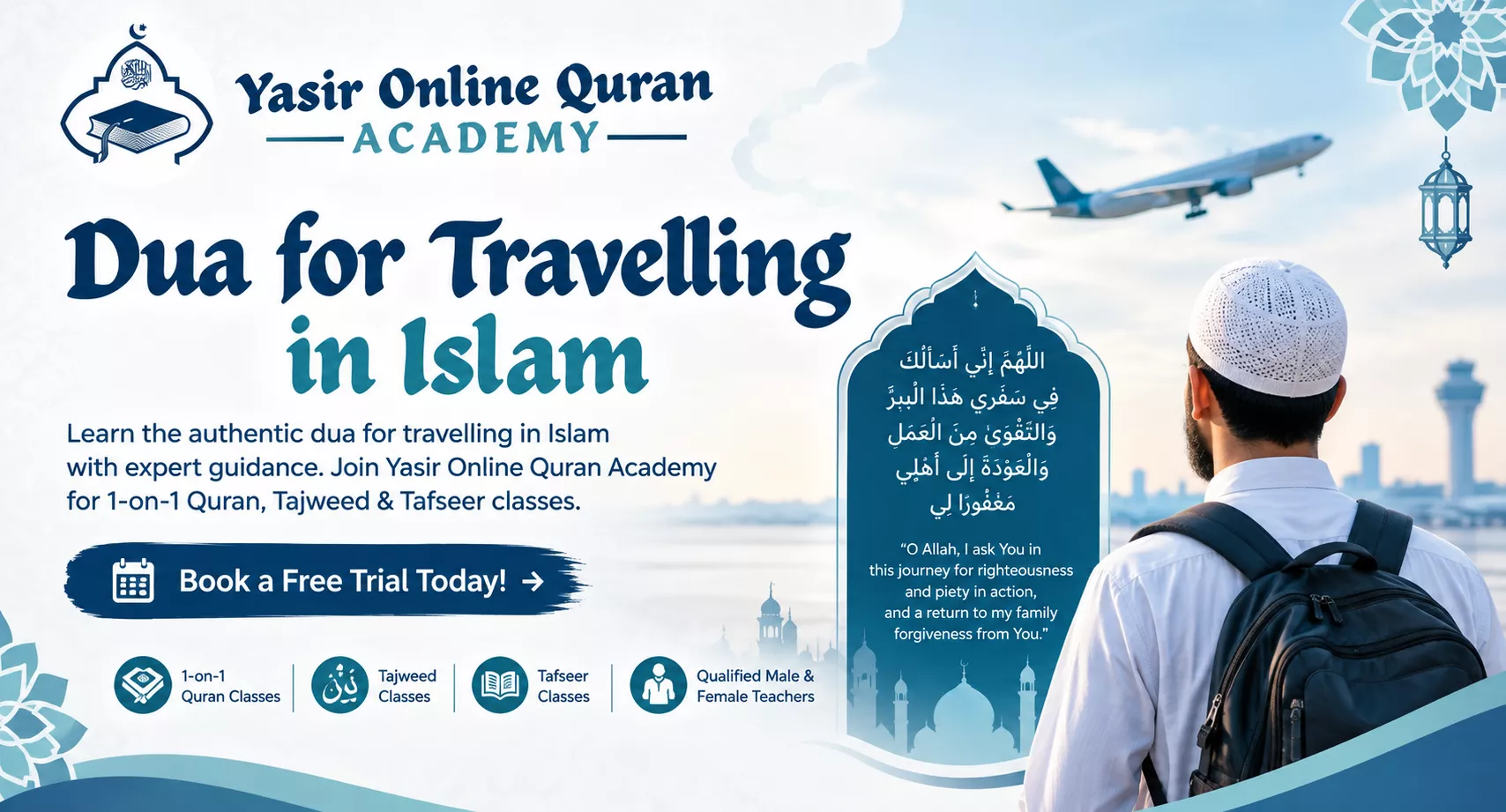
The authentic dua for travelling in Arabic reads: “اللَّهُمَّ إِنَّا نَسْأَلُكَ فِي سَفَرِنَا هَذَا الْبِرَّ وَالتَّقْوَى.” Its transliteration is “Allahumma inna nas’aluka fi safarina hadhal-birra wat-taqwa,” meaning “O Allah, we ask You for righteousness and piety on this journey.” This exact wording is recorded in Sahih Muslim.
Getting the dua e safar transliteration right matters more than most people realize. Mispronounced Arabic can shift meaning entirely, so precision counts here. Below is a clean breakdown you can reference anytime, whether you’re memorizing it fresh or double-checking wording you learned years ago.
| Arabic | Transliteration | English Meaning |
| اللَّهُمَّ إِنَّا نَسْأَلُكَ فِي سَفَرِنَا هَذَا الْبِرَّ وَالتَّقْوَى | Allahumma inna nas’aluka fi safarina hadhal-birra wat-taqwa | O Allah, we ask You for righteousness and piety on this journey |
| وَمِنَ الْعَمَلِ مَا تَرْضَى | wa minal-‘amali ma tarda | And for deeds that please You |
Many students search for a dua for travelling PDF to save offline, which makes sense given how often travel plans come together last minute. The table above works exactly like that reference sheet. If you’d rather hear it recited correctly and repeat it back with live feedback, Yasir Online Quran Academy tutors walk through this line by line during sessions.
2. Safar Ki Dua – The Sunnah Way to Begin Your Journey
Safar ki dua refers to the complete Sunnah sequence for starting a journey: saying Bismillah, reciting the travel supplication, and saying Takbir three times upon boarding your transport. This full sequence is narrated by Ibn Umar in Sahih Muslim.
The Sunnah method isn’t complicated, but sequence matters. You start with Bismillah, move into three declarations of Allahu Akbar, then recite the full dua while settled in your seat. Skipping the order isn’t sinful, yet following it connects your journey to exactly how the Prophet ﷺ traveled fourteen centuries ago.
3. Dua for Safe Journey by Car, Bus, Train & Air Travel
The dua for safe journey applies identically across car, bus, train, and air travel, because the supplication addresses the act of traveling itself, not the vehicle. Islamic scholars confirm no separate wording exists for flights versus road trips. One dua covers every mode of transport.
A lot of people searching for dua for flight travel assume airplanes need something different. They don’t. Whether you’re settling into a car seat or buckling in before takeoff, the same words apply. What changes is simply the moment you recite them: right as you begin moving.
That said, context still shapes the experience. A dua for road trip in Islam might feel more casual, said quickly before pulling out of the driveway, while air travel often invites a calmer, more deliberate recitation during boarding. Either way, the dua while boarding a vehicle stays fixed. Only your surroundings change, never the wording itself.
4. Benefits of Reciting the Travel Dua Before Every Journey
Reciting the travel dua builds tawakkul, or reliance on Allah, while inviting Allah’s protection during journey through sincere remembrance. It grounds travelers in mindfulness before departure rather than rushing off distracted. Scholars tie this habit to the broader Quranic principle of seeking divine help before any undertaking.
- It shifts your mindset from anxious rushing to calm intention before you even leave the driveway.
- It invokes spiritual protection, something especially comforting during long-distance or solo travel.
- It builds a consistent habit of remembering Allah in everyday, non-ritual moments.
5. When and How to Recite Dua for Travelling (Sunnah Method)
Recite the dua immediately after settling into your seat, right before the journey begins, following this order: Bismillah, Takbir three times, then the full supplication. This sequence is preserved in Sahih Muslim through the narration of Ali ibn Abi Talib. Timing and order both matter here.
Getting the timing right isn’t about being rigid. It’s about building a habit you’ll actually remember under pressure, like a delayed flight or a chaotic school run. Say it once you’re seated and settled, not while still juggling bags or searching for your ticket at the gate.
Here’s the exact Sunnah of travelling in Islam, broken into a simple sequence you can follow every single time:
- Say “Bismillah” as you board your car, bus, train, or plane.
- Recite “Allahu Akbar” three times once you’re seated.
- Recite the full travel dua slowly, focusing on its meaning rather than rushing the words.
6. Dua for Returning Home Safely from a Journey
The dua for returning from a journey includes the phrase “Ayibuna, ta’ibuna, ‘abiduna, li-rabbina hamidun,” meaning travelers return repentant, worshipping, and praising their Lord. This is recorded in Sahih al-Bukhari and differs from the departure supplication.
Most people memorize the outbound dua and completely forget there’s a return version. That’s a missed opportunity, honestly. Saying this dua as you pull back into your neighborhood or step off the plane closes the journey with the same intentionality it began with, full circle, gratitude included.
7. Other Important Duas for Travellers in Islam
Beyond the core supplication, Islam prescribes situational duas covering a dua for entering a new place, seeking refuge upon stopping somewhere unfamiliar, and facing sudden travel difficulty. Each carries its own hadith source. These duas address moments the main travel dua doesn’t specifically cover.
Travel rarely goes exactly to plan, and Islamic tradition accounts for that beautifully. There’s guidance for musafir (traveler) rulings in Islam covering everything from unexpected delays to arriving somewhere new after dark, giving you a complete spiritual toolkit rather than just one memorized line.
| Situation | Purpose |
| Entering a new town or city | Seeking protection from unseen harm |
| Stopping to rest during travel | Requesting refuge through Allah’s perfect words |
| Facing hardship mid-journey | Asking for patience and relief |
It’s also worth understanding related travel rulings while you’re at it, like qasr prayer during travel. Shortening prayers while travelling is a genuine concession in Islam, not a shortcut people invented. Combined with these situational duas, it shows how comprehensively Islamic teaching addresses the traveler’s daily reality.
8. Learn Authentic Duas & Quran Recitation with Yasir Online Quran Academy
Yasir Online Quran Academy offers structured 1-on-1 Quran classes teaching authentic duas, correct Arabic pronunciation, and complete Quran recitation with certified tutors. The curriculum blends learn Tajweed online instruction with practical dua memorization built for daily life, including travel.
Reading a transliteration online only gets you so far. Real fluency comes from hearing correct pronunciation and getting corrected in real time, which is exactly what online Quran classes for kids and adults at Yasir Online Quran Academy deliver, one student, one tutor, fully personalized to your pace.
Whether you’re a complete beginner or refreshing childhood lessons, the academy’s online Quran teacher for beginners programs cover Tajweed rules, Quran memorization (Hifz) classes, and Quran translation and Tafseer classes, so you understand meaning, not just sound. Everything is built around live, human instruction, not recorded videos.
9. Why Choose Yasir Online Quran Academy for 1-on-1 Quran & Dua Learning
Yasir Online Quran Academy stands out through certified male and female Quran tutors online, flexible scheduling across time zones, and a personalized curriculum built around each student’s pace. It’s regularly recognized among families searching for the best online Quran academy for serious, structured learning.
“Consistency beats intensity every time. A student who studies twenty focused minutes daily with the right tutor progresses further than one cramming for hours occasionally.” This is the philosophy baked into every class structure the academy builds around its students.
Every tutor here undergoes vetting for both Tajweed accuracy and teaching ability, not just religious knowledge. That distinction matters enormously for beginners who need patience and clear explanation, not just correct recitation. Progress tracking keeps both students and parents genuinely informed every step of the way.
Book Your Free Trial Class Today
Yasir Online Quran Academy offers a free trial class so new students can experience personalized, 1-on-1 instruction before enrolling in any paid program. Booking takes just a few minutes online. No long-term commitment is required to get started.
There’s no better way to judge teaching quality than experiencing it firsthand. Book your free trial today, get matched with a qualified tutor suited to your level, and start learning authentic duas and Quran recitation the right way, one guided session at a time.
Frequently Asked Questions
- What is the dua for travelling in Islam?
It’s a Sunnah supplication recited before starting a journey, asking Allah for righteousness, ease, and protection. The exact wording is preserved in Sahih Muslim. - Is the same dua used for flights, cars, and trains?
Yes. The dua addresses the act of traveling itself, not the vehicle, so one supplication covers every mode of transport. - When should you recite the travel dua?
Recite it right after boarding and settling into your seat, following the sequence of Bismillah, Takbir three times, then the full dua. - Is there a different dua for returning home?
Yes. The return dua, “Ayibuna, ta’ibuna, ‘abiduna, li-rabbina hamidun,” is separate from the departure supplication and recorded in Sahih al-Bukhari. - Can I learn these duas properly with Yasir Online Quran Academy?
Yes. Certified tutors teach correct pronunciation, meaning, and Sunnah context through live, personalized 1-on-1 sessions, starting with a free trial class.